Drone disclaimer: read before you fly
You fly at your own risk. You are responsible for knowing and following all current federal, state, and local laws every time you fly, including FAA rules and Texas law.
The Waxahachie Tiny Home and its hosts are not responsible for any laws you break, or for any damage, injuries, or fines that come from your flight.
The rules on this page are a starting point, checked in October 2026. Laws change, and this isn't legal advice.
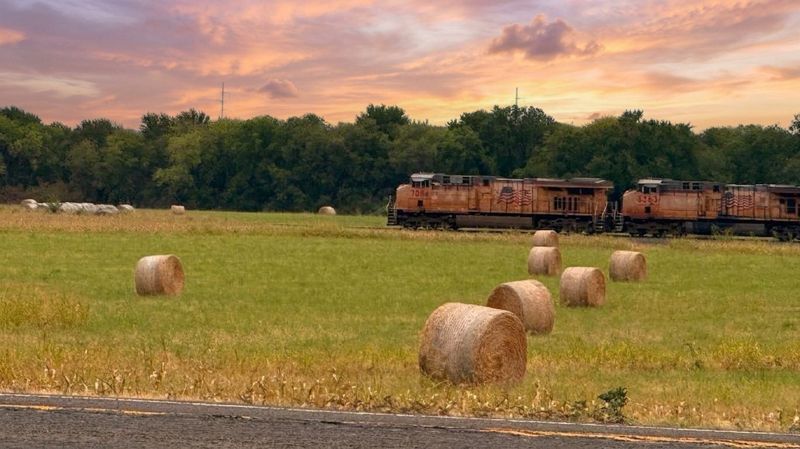
Drone pilots spend half their time looking for somewhere to fly. Out here, the sky opens up in every direction: farmland to the horizon, round hay bales, freight trains on the far line, and sunsets that look staged.
At a glance
- Launch pad
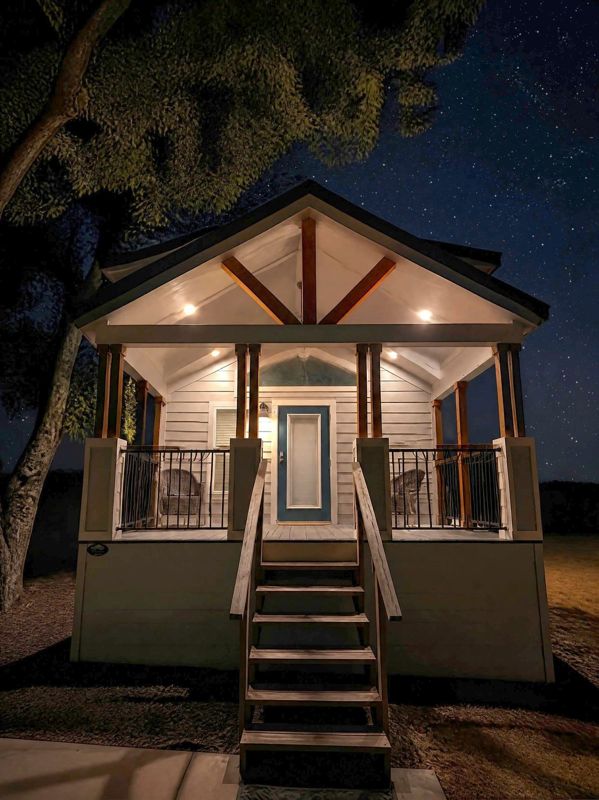
- The tiny home's yard, with open farmland all around
- Before you fly
- Pass TRUST, register if your drone is 250 grams or more, fly with Remote ID, and check the airspace
- Best light
- Calm mornings and golden hour
- From Dallas
- About 35 minutes south
- Whose call
- Yours. You're responsible for every flight
Fly from the tiny home
- Take off from the yard and fly wherever the law allows. We don't limit flights over the surrounding farmland.
- Be a good neighbor: stay high over homes, livestock, and anyone working the fields, and don't hover over people or film into windows. Flying over the neighboring farmland is fine as long as you follow FAA rules and Texas law; that part is on you. Just launch and land from our yard, since the fields themselves are private property.
- Charge smart: charge batteries on a hard surface you can see, never on a bed or couch.
- Paid shoots at the tiny home need our approval first. See the photo and film guide.
Shots worth flying for
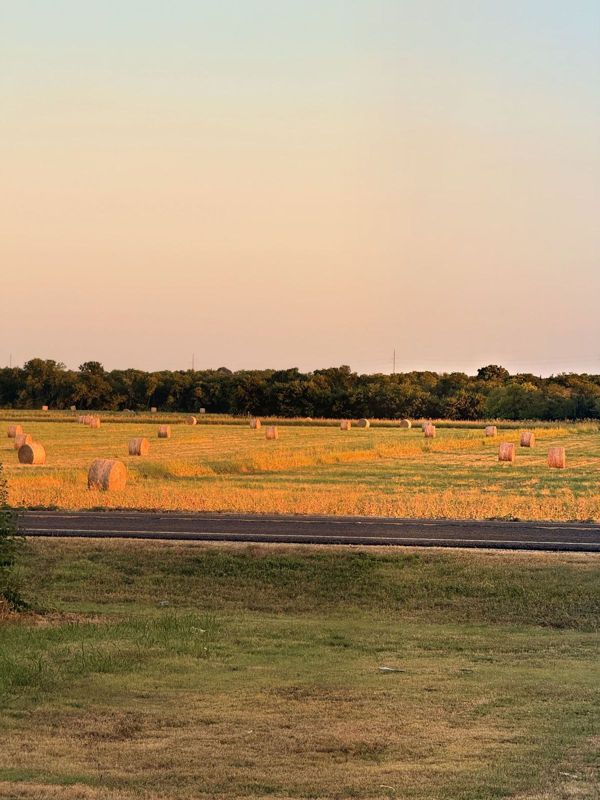
Hay bales from straight above
Tilt the camera straight down over the fields after a cutting. Round bales turn into a pattern that looks like art.
The orbit
Circle the tiny home at 50 to 100 feet as the sky turns pink. Slow and steady sells it.
Porch to horizon
Start low by the porch steps and rise straight up until the farmland fills the frame to the skyline.
The freight train
Hold a hover well off to the side and let a train roll into frame at sunset. Never fly over a moving train. Our train watching guide has more on the line.
Storms rolling in
Out here you can watch a storm build from miles away. Grab the shot early and land before the wind and lightning arrive.
Sunset hyperlapse
Park the drone in a hover and let the hyperlapse mode turn 20 minutes of sunset into 10 seconds.
More spots to shoot from the ground, from trains to Victorian homes, are in our photo and film guide.
New pilot? Start here
Flying for fun
- Pass TRUST, The Recreational UAS Safety Test. It's free online through FAA-approved administrators, including the Academy of Model Aeronautics. Save your certificate, because they don't keep records, and be ready to show it if law enforcement or the FAA asks.
- Register drones of 250 grams or more at FAA DroneZone: $5, good for three years, and one registration covers all your drones. You must be 13 or older. Drones under 250 grams flown for fun don't need registration.
- Label each drone with your registration number, carry proof of registration, and make sure it broadcasts Remote ID (see below).
- Fly the basics: at or below 400 feet in uncontrolled airspace, always in your line of sight, and by the safety guidelines of an FAA-recognized community-based organization.
Flying for pay
- Real estate, client work, and anything for a business falls under Part 107. The FAA's advice: "When in doubt, assume Part 107."
- To get certified: be 16 or older, create an IACRA profile, pass the knowledge test at an FAA-approved testing center, and clear a TSA check. The FAA says the test costs about $175.
- Find a test seat by entering your ZIP code in the "Find a Test Center" tool on PSI's FAA test center page. If nothing shows near Dallas or Waxahachie, PSI lets you request a seat.
- Register each drone separately for Part 107: $5 per drone, good for three years. A drone registered for fun can't be flown under Part 107.
- Stay current with the FAA's free online recurrent training every 24 calendar months.
- Night flights under Part 107 need anti-collision lights visible for 3 statute miles, plus the updated test or training (14 CFR 107.29). The lights are also required in civil twilight, the 30 minutes before sunrise and after sunset, so late sunset shots count.
Remote ID
- Who needs it: any drone that has to be registered must broadcast Remote ID, whether you fly for fun or for pay. It's been required since September 16, 2023.
- Two ways to comply: buy a drone with Remote ID built in, or add a broadcast module. With a module, you must keep the drone in sight the whole flight.
- Not sure about yours? Look up your model in the FAA's UAS Declaration of Compliance system. Only manufacturers file declarations.
- No Remote ID? You can only fly inside an FAA-recognized identification area (FRIA), in line of sight.
Check the airspace, every flight
- Use an FAA-approved app such as B4UFLY before every flight. It shows controlled airspace, airports, and temporary flight restrictions where you're standing.
- Need controlled airspace? Get authorization first through LAANC (near-real-time, in FAA-approved apps) or FAA DroneZone. Recreational flyers can use LAANC once they've passed TRUST and registered. LAANC only clears the airspace, so check NOTAMs and weather yourself.
- Near Dallas: expect controlled airspace around DFW, Love Field, and other airports. The app map shows exactly where.
- Game days: the FAA bans drones within 3 nautical miles of stadiums with 30,000 or more seats, up to 3,000 feet, from an hour before to an hour after NFL, MLB, and NCAA Division I football games and NASCAR Cup, IndyCar, and Champ Series races. That covers AT&T Stadium and Globe Life Field; see our game day guide for the rest of the trip.
Closest to us is Mid-Way Regional Airport, which serves both Midlothian and Waxahachie.
Mid-Way Regional Airport
It has no control tower, so pilots there watch for each other by eye and radio. Check B4UFLY before every flight in this area, and stay well clear of the runway and the planes around it.
Texas drone laws in 2026
The FAA runs the airspace. Texas adds its own rules on the ground and on what you capture, mostly in Government Code chapter 423 (not the Penal Code). As of October 2026:
| Rule | What it says |
|---|---|
| Surveillance | Using a drone to capture an image of a person or privately owned real property with intent to conduct surveillance is a Class C misdemeanor (Gov't Code 423.003). Possessing or sharing those images is a separate offense (423.004). |
| Lawsuits | Property owners and tenants can sue over those images (423.006). The penalties are $5,000 for images captured in a single episode and $10,000 for sharing or using them, and suits must be filed within two years. |
| Critical infrastructure | Flying at or below 400 feet over a critical infrastructure facility is a Class B misdemeanor (423.0045). The list includes refineries, power plants and substations, water treatment facilities, high-hazard dams, natural gas compressor stations, and large livestock feeding operations when fenced or posted, plus fenced oil and gas sites. |
| Big sports venues | Flying at or below 400 feet over a stadium, arena, or racetrack with 30,000 or more seats is a Class B misdemeanor (423.0046). A repeat offense under either section is a Class A misdemeanor. |
| Local rules | Cities and counties generally can't write their own drone rules, with narrow exceptions like special events and their own facilities (423.009). Watch for posted signs in city parks. |
| State parks | Texas Parks and Wildlife allows drones in state parks in two cases: a designated area at Martin Dies Jr. State Park, or filming with a permit from the park. At Cedar Hill State Park, (972) 291-3900, that means a filming permit. |
| Army Corps lakes | Under 36 CFR 327.4, aircraft can't operate on Corps lake lands except at locations the district commander designates, and the Corps counts drones as aircraft. That covers Joe Pool Lake and Bardwell Lake. Call the lake office before you go: Bardwell Lake, (972) 875-5711. |
| Wildlife | Texas Parks and Wildlife says using a drone to hunt, drive, capture, count, or photograph wildlife is unlawful without an Aerial Management Permit and a landowner authorization. A violation can be a Class A misdemeanor. |
| Takeoff and landing | You need the owner's permission to launch from or land on someone else's property. Entering without it can be criminal trespass (Penal Code chapter 30). |
The criminal rules have exceptions, including for FAA-compliant commercial operators, government and law enforcement, and people with the owner's written consent (423.002, 423.0045, 423.0046). Check the current law yourself; it changes. Primary sources: Texas Government Code chapter 423, TPWD park rules, 36 CFR 327.4, and the FAA recreational flyer rules.
Where else to fly near Dallas
- Private land, with the owner's yes. The simplest, least stressful option, like our yard.
- Model aircraft club fields. Academy of Model Aeronautics clubs run flying fields around DFW; the AMA's club finder lists them. Two RC clubs we found are Golden Triangle RC Club in Grand Prairie, (972) 339-8537, and Greater Southwest Aero Modelers, 6903 Randol Mill Rd., Fort Worth, (682) 408-1830. These are club fields, so call first and ask whether drones and guests are welcome.
- A drone racing field. Dallas Drone Racing is at 2304 Sandy Lake Rd., Carrollton. No phone is listed, so confirm when and who can fly before you drive up.
- State parks and Corps lakes: only where the agency allows it. See the table above, and call the park or lake office first.
- City parks: check with the parks department first, and follow posted signs. Waxahachie Parks and Recreation is at 401 S. Elm St., (469) 309-4000.
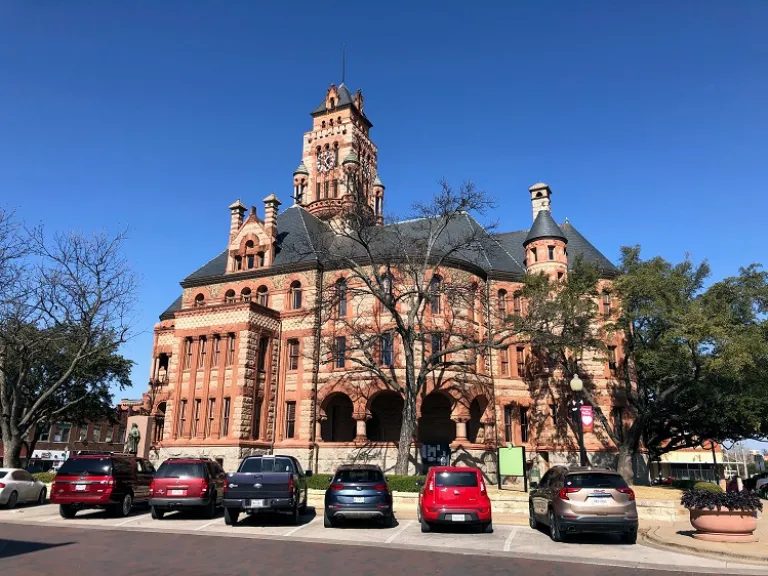
- Skip downtown Waxahachie. Busy streets, people, and power lines make it a poor place for a casual flight. Shoot the courthouse from the ground.
Camera settings that work out here
| Shooting | Starting point |
|---|---|
| Smooth video | Shutter at about twice your frame rate: 1/50 at 24 fps, 1/60 at 30 fps, 1/120 at 60 fps. |
| Bright Texas sun | You'll need a strong ND filter, around ND32 to ND64 at midday, to hold that shutter speed. ND8 to ND16 at golden hour. |
| Color | Lowest ISO, with a log or flat profile if you'll color-grade; standard color if you won't. |
| Sunset stills | RAW, with auto exposure bracketing to hold the bright sky and the dark fields. |
| Big views | Panorama mode for the farmland; it stitches the horizon for you. |
Golden hour and sunset times for every month are in our photo guide.
Wind, heat, and fire ants
- Wind: North Texas gets gusty, especially in spring, and it's usually windier at 400 feet than on the porch. Check wind at altitude in a forecast app, and come home with battery to spare.
- Heat: don't leave batteries in a hot car, and let them cool before you charge.
- Fire ants: they build loose dirt mounds in the grass. Launch from a landing pad or the driveway, not the lawn.
- Lightning: if you can hear thunder, you're done flying.
Questions we get
Can I fly a drone at The Waxahachie Tiny Home?
Yes. Take off from the property and fly wherever the law allows; we don't limit flights over the surrounding farmland. You're responsible for following all federal, state, and local laws, and we're not responsible for any laws broken.
Are drones legal in Texas?
Yes. You have to follow FAA rules and Texas law, mainly Government Code chapter 423, and you're responsible for knowing both before every flight.
Do I need a license to fly a drone in Texas?
For fun, you need to pass the free TRUST test and register any drone that weighs 250 grams or more. For paid work, like real estate or client shoots, you need an FAA Part 107 Remote Pilot Certificate.
Is it legal to fly a drone over private property in Texas?
The FAA regulates the airspace, but Texas adds its own limits: it's a crime to use a drone to capture images of people or private property with intent to conduct surveillance, and to fly at or below 400 feet over critical infrastructure or big sports venues. Owners can also sue over those images. You need permission to take off or land on someone else's land, and you're responsible for knowing the current law before you fly.
Where can I fly my drone near Dallas?
Private land where the owner says yes is the simplest answer, and our tiny home's yard is one. Club fields can work too if the club says yes, so call first. Check every spot in an FAA-approved app, and remember that state parks and Army Corps lakes like Joe Pool and Bardwell allow drones only in limited cases.
Do I need to register my drone?
If it weighs 250 grams or more, yes. Registration costs $5 at FAA DroneZone, lasts three years, and for recreational flyers covers all your drones. Part 107 drones are registered one at a time.
Does my drone need Remote ID?
If it has to be registered, yes. Use a drone with Remote ID built in, add a broadcast module, or fly only inside an FAA-recognized identification area.
Can I fly a drone in Texas state parks?
Usually not. Texas Parks and Wildlife allows drones in a designated area at Martin Dies Jr. State Park, and for filming with a permit from the park elsewhere. Ask the park office before you go.
What is the TRUST test?
The Recreational UAS Safety Test, the FAA's required test for hobby pilots. It's free online through FAA-approved test administrators, and you keep your own certificate, because they don't keep records.
How much is the Part 107 test, and where do I take it near Dallas?
The FAA says it costs about $175. Search PSI's test center tool by ZIP code for the closest FAA-approved center, and use its seat request option if nothing is open near you.
About this guide
Written by the hosts of The Waxahachie Tiny Home, a family-run rental on farmland just outside Waxahachie. We checked the details on this page against official sources and update it as things change. Hours, prices, and dates move around, so confirm before you go.
Last updated October 17, 2026
Looking to be included in our guides?
Run a restaurant, shop, venue, or something fun nearby? Send us your details and why we should include you.