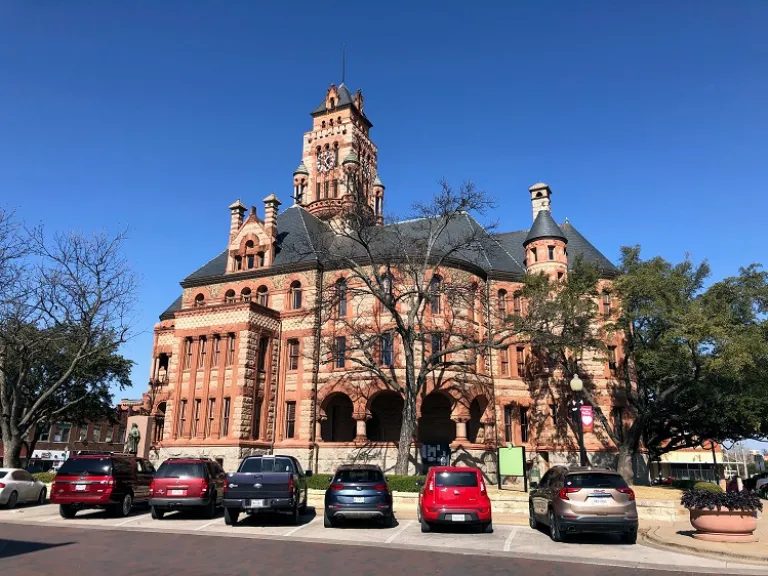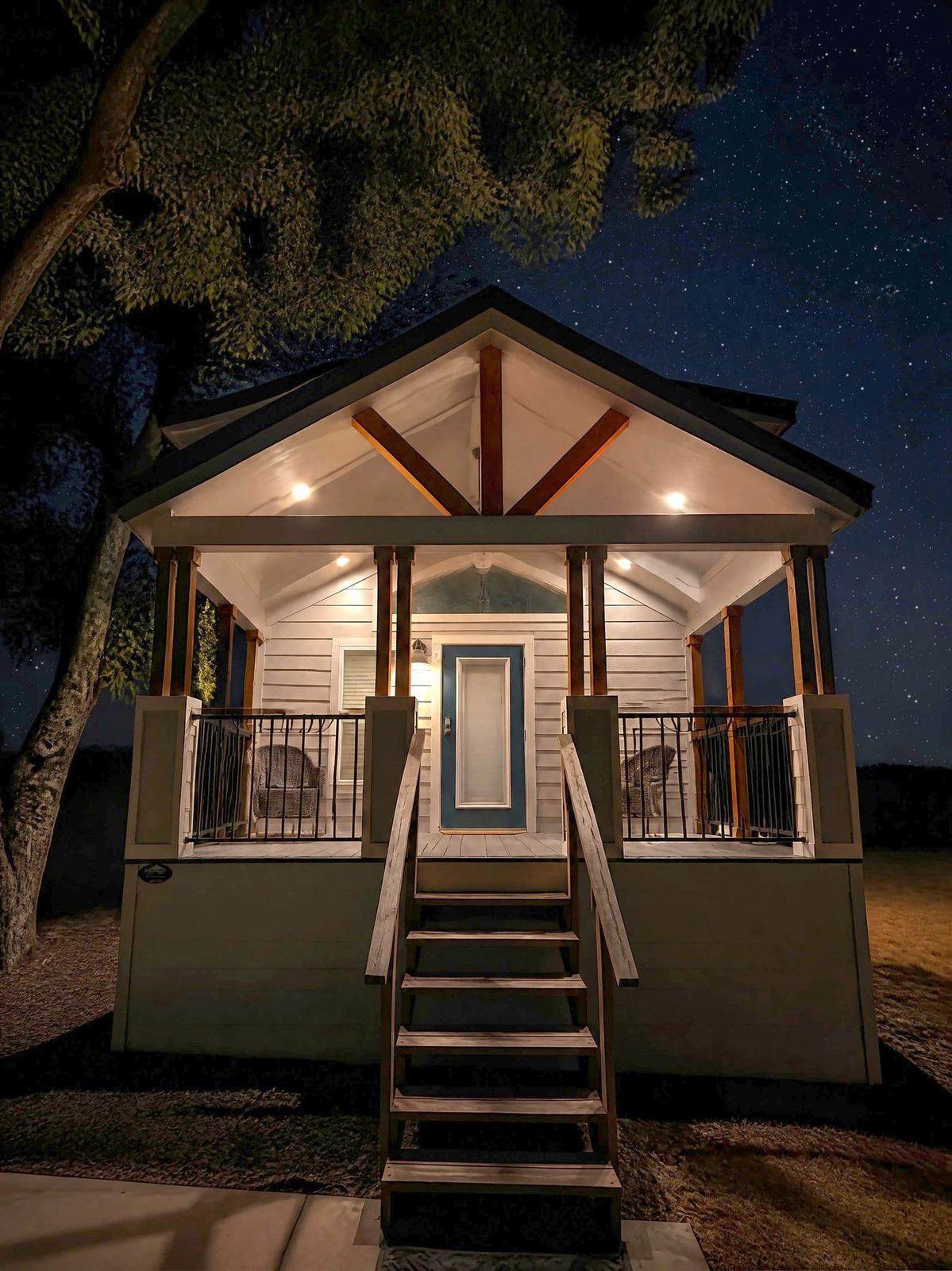
There's a reason our listing says "a sea of stars." Out here, the sky comes down to the fields on every side, and on a clear, moonless night you'll stop counting.
At a glance
- Next big shower
- The Geminids, December 13 to 14, 2026, with the Moon down by 9:30 p.m.
- Planet now
- Saturn at opposition on October 4, 2026, up all night
- Supermoons
- November 24 and December 23, 2026, and January 22, 2027
- Milky Way season
- Spring through early fall, low in the south; best June to August
- Texas bonus
- Canopus and Omega Centauri, too far south for most of the U.S.
Moon phases, planet events, and star positions computed for the tiny home's location in Central Time. Meteor dates from almanac.com and space.com; eclipses from space.com. Checked October 3, 2026.
Our sky, honestly
- We're about 32.4 degrees north, so Polaris sits about 32 degrees above the northern horizon, and the sky reaches farther south than it does for most of the country.
- Dallas glows on the northern horizon, about 35 miles away, and Waxahachie lights the west a little. Face south and east for the darkest sky.
- It's dark country, not a certified dark-sky park. You'll see far more than in town: the bright Milky Way on summer nights, meteor showers, and star clusters with your bare eyes.
- The Moon matters most. Plan big nights around the new Moon. The calendar below tells you which nights are dark.
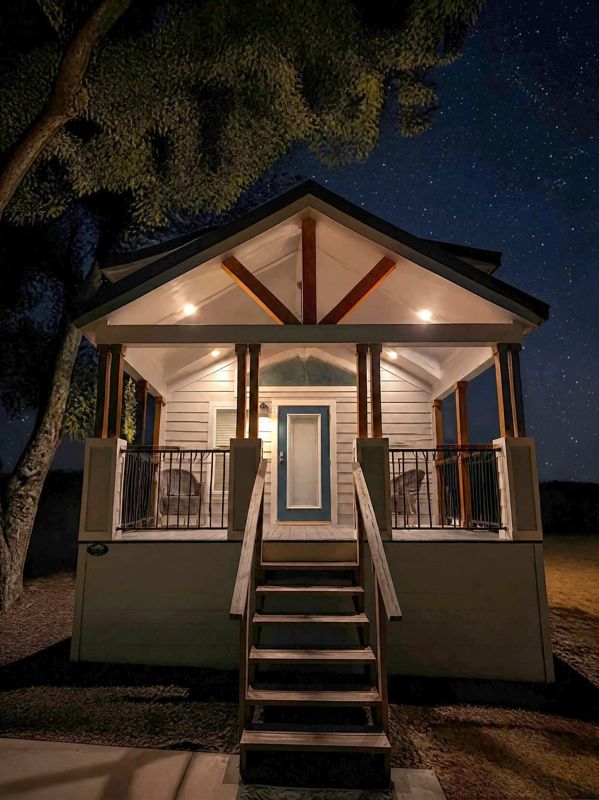
- Watch from the porch or the yard. The rocking chairs face open farmland, and you can be looking up 30 seconds after you turn off the lights.
2026-27 sky calendar
Times are Central and computed for the tiny home. Meteor rates are for dark skies with the radiant high; expect fewer.
Fall 2026
| When | What and when to look |
|---|---|
| Oct 4 | Saturn at opposition. Closest and brightest of the year, up all night. Any small telescope shows the rings. |
| Oct 8 to 9 | Draconids. Usually only a handful per hour, but the Moon is nearly new. Unlike most showers, it's best in the early evening. |
| Oct 21 to 22 | Orionids, debris from Halley's Comet, about 20 per hour. An 83% Moon sets at 3:51 a.m., so watch from 4 a.m. to dawn. |
| Nov 4 to 5 | Southern Taurids. Slow, few, and famous for fireballs. A thin crescent doesn't rise until 3:20 a.m. |
| Nov 11 to 12 | Northern Taurids. More slow fireballs, with almost no Moon. |
| Nov 14, before dawn | Mars and Jupiter about 1.4 degrees apart, high in the southeast an hour before sunrise. |
| Nov 16 to 17 | Leonids, about 10 to 15 per hour. The half Moon sets at 11:39 p.m.; the hours after midnight are dark. |
| Nov 24 | Supermoon (Beaver Moon), full at 8:53 a.m.; look the evenings before and after. |
Winter 2026-27
| When | What and when to look |
|---|---|
| Dec 13 to 14 | Geminids, the best shower of the year: up to about 120 per hour under ideal skies, and bright, colorful meteors. The 23% crescent sets at 9:30 p.m., so it's dark all night. Start around 10 p.m. |
| Dec 22 to 23 | Ursids, about 5 per hour, washed out by a nearly full Moon. |
| Dec 23 | Supermoon (Cold Moon), full at 7:28 p.m.: the closest full Moon of this run, rising at dusk. |
| Jan 3, 2027 | Venus at greatest elongation, its farthest from the Sun in our sky, blazing as the morning star in the southeast before dawn. |
| Jan 3 to 4 | Quadrantids. A sharp, short peak with dozens per hour if you catch it. The thin crescent rises at 5:06 a.m., so watch before that. |
| Jan 22 | Supermoon (Wolf Moon), full at 6:17 a.m. |
| Late Jan to mid-Feb | Comet 2P/Encke may reach about magnitude 6: a binocular target, not a naked-eye show. Check a comet tracker for its position. |
| Feb 10 | Jupiter at opposition, up all night. Binoculars show its four big moons. |
| Feb 19 | Mars at opposition, a bright orange point all night. |
| Feb 20 | Penumbral lunar eclipse on the full Snow Moon: a subtle shading, not a red Moon. |
Spring, summer, and fall 2027
| When | What and when to look |
|---|---|
| Apr 21 to 22 | Lyrids, about 10 to 20 per hour, mostly washed out by a 98% Moon. |
| May 5 to 6 | Eta Aquariids, Halley's Comet debris again, with a new Moon. Watch the last two hours before dawn, low in the east. |
| Jul 29 to 30 | Southern Delta Aquariids. A thin crescent rises at 3:16 a.m.; watch before then. |
| Aug 12 to 13 | Perseids, up to about 50 to 100 per hour under dark skies. An 86% Moon sets at 3:17 a.m., so watch from 3:30 a.m. to dawn. |
| Aug 17 | Penumbral lunar eclipse, a faint shading around the 2:28 a.m. full Moon. |
| Oct 17 | Saturn at opposition again. |
| Nov 22 | Venus and Mars about 1 degree apart, low in the southwest after sunset. |
| Dec 13 to 14 | Geminids, sadly under a full Moon this time. |
| Jan 12, 2028 | Partial lunar eclipse, just a 3% nibble, 9:43 to 10:42 p.m., with the Moon high in the sky. |
No solar eclipse crosses Texas in 2026 or 2027. The last one was a big one: on April 8, 2024, the total eclipse passed right over Waxahachie.
Constellations by season
What's high around 9 to 10 p.m. Use a star app the first night; by the second, you won't need it.
Fall
Look high overhead and northeast
The Great Square of Pegasus overhead, Andromeda trailing off it with the Andromeda Galaxy, a faint smudge 2.5 million light-years away that's highest around early November. Cassiopeia's W in the northeast, the Summer Triangle setting in the west, and lonely Fomalhaut low in the south.
Winter
Look south and overhead
Orion and his belt, with the Orion Nebula glowing in his sword (highest around late January). Taurus with red Aldebaran and the Pleiades, nearly overhead around Christmas. Gemini, Auriga with Capella, and Sirius, the brightest star in the sky, in Canis Major.
Spring
Look high in the north, then south
The Big Dipper rides high. Follow the arc of its handle to orange Arcturus in Bootes, then speed on to Spica in Virgo. Leo's backward question mark crosses the south, with the Beehive Cluster in Cancer just west of it.
Summer
Look south and straight up
Scorpius crawls along the southern horizon with red Antares, and from Texas you see its whole curled tail. Sagittarius's teapot pours out the brightest part of the Milky Way. Overhead, Vega, Deneb, and Altair make the Summer Triangle, and Hercules carries the great globular cluster M13.
The northern sky
Look north
Polaris holds still about 32 degrees up. The Little Dipper and Cepheus never set from here, while the Big Dipper and Cassiopeia take turns dipping toward the horizon.
Texas-only bonus stars
Being this far south shows you things most of the country never sees. You need a flat, clear southern horizon, and farmland is perfect for it.
- Canopus, the second-brightest star in the sky, peeks just 5 degrees above the southern horizon around 10 p.m. in early February.
- Omega Centauri, the biggest globular cluster in our galaxy, rises about 10 degrees high around 10 p.m. in early June. In binoculars it's a fuzzy ball of millions of stars.
- The Milky Way core climbs about 29 degrees above the southern horizon, highest around 10 p.m. in early August.
Planets: where to look
- Fall 2026: Saturn owns the evening, low in the southeast at dusk. Jupiter and Mars rise late and shine high before dawn.
- Winter 2026-27: Venus is the brilliant morning star from November into February. Jupiter and Mars move into the evening sky, both up all night by February. Saturn fades into the western evening glow.
- Spring and summer 2027: Mars and Jupiter hang in the evening sky, and Saturn returns before dawn by June.
- Fall 2027: Saturn takes over the evening again, and Venus slides into the evening sky by December.
- Mercury, the hardest one: try low in the west after sunset in late May 2027, or low in the east before sunrise in late November 2026.
Planets don't twinkle like stars do. A steady, bright light near where the Sun and Moon travel is almost always a planet.
How to watch a meteor shower
- Check the Moon first. A bright Moon cuts what you see more than anything else. The calendar above shows when it sets.
- Go late. For most showers, the best hours are after midnight, when your side of the Earth faces into the debris stream.
- Get comfortable. Lie back in a reclining chair or on a blanket, facing the darkest part of the sky. You don't need to stare at the radiant; meteors streak across the whole sky.
- Give your eyes 20 minutes, and keep the phone away. One glance at a bright screen resets your night vision.
- Stay at least an hour. Meteors come in clumps and lulls. The patient people see the fireballs.
Satellites, comets, and auroras
- The International Space Station looks like a bright, steady light gliding across the sky in a few minutes, usually just after dusk or before dawn. Sign up for NASA's Spot the Station alerts for Waxahachie.
- Starlink trains, a line of dots moving together, show up a day or two after a launch, low after dusk.
- Comets are hard to predict. When a bright one appears, we'll update this page.
- Auroras are rare this far south, but the big solar storm of May 2024 put them over North Texas. Watch the NOAA Space Weather Prediction Center for strong geomagnetic storm alerts, then look north.
Astrophotography tips
With your phone
- Steady beats everything: a small tripod or a phone propped on the porch rail.
- Use night mode or the astrophotography mode, and let it run its longest exposure. Turn the flash off.
- Tap to focus on a bright star or planet, then don't touch it.
- Frame something: the tiny home's roofline, the porch posts, a hay bale. A foreground makes a star photo.
With a camera
| Shot | Starting settings |
|---|---|
| Stars and Milky Way | Widest aperture (f/1.8 to f/2.8), ISO 1600 to 3200, 15 to 25 seconds on a wide lens. Keep stars sharp with the 500 rule: 500 divided by your focal length (on a crop sensor, multiply the focal length by 1.5 first). |
| Star trails | Lots of 20 to 30 second frames back to back for an hour or more, stacked with free software like StarStaX or Sequator. |
| Meteors | A wide lens pointed about 45 degrees away from the radiant, shooting continuous 15 to 25 second frames with an intervalometer. Most frames will be empty; the keepers are worth it. |
| The Moon | Base ISO, f/8, around 1/125 to 1/250 second at 300mm or longer. Shoot a few days off full for craters on the shadow line. |
| Planets | Hold your phone camera to a telescope or braced binocular eyepiece. Jupiter's moons and Saturn's rings are very doable. |
The basics that make or break the shot
- Focus by hand: zoom into a bright star in live view and turn the ring until it's a pinpoint.
- Shoot RAW, set white balance around 3800 to 4200K, and use a 2-second timer or a remote.
- Turn off image stabilization on a tripod.
- Light the house for one second with a dim flashlight mid-exposure for that glowing-cabin look.
- The Milky Way core is in the south, away from the Dallas glow. Best months: June to August around 10 p.m. to 1 a.m.; in spring, look before dawn.
What to bring
- A red flashlight, or red tape over a regular one, to keep your night vision
- A reclining camp chair or a thick blanket
- Binoculars: 7x50 or 10x50 are perfect for the Moon, star clusters, and Jupiter's moons
- Layers, even in spring and fall; Texas nights cool off fast
- Bug spray in summer, and a hand towel for the dew that soaks everything by midnight
- A star app such as Stellarium or SkySafari, set to night mode, plus Clear Outside for the cloud forecast
Watch your step in the grass at night. Fire ants and the occasional snake are part of country life, so keep to the porch and the yard and bring a light.
Star parties and planetariums
UTA Planetarium
700 Planetarium Pl., Arlington
A full-dome planetarium on the University of Texas at Arlington campus, rated 4.4 stars, with Saturday evening shows.
Public star parties
Around DFW
Local astronomy clubs, including the Fort Worth Astronomical Society and the Texas Astronomical Society of Dallas, set up telescopes for the public. Find upcoming ones on the NASA Night Sky Network.
Why stay with us
- No drive home in the dark. The best meteor hours are after midnight. Here, bed is 30 steps away.
- A porch made for looking up, with rocking chairs facing open farmland.
- Extremely quiet, so you'll hear crickets instead of traffic.
- A full kitchen for midnight snacks and an early breakfast after a 4 a.m. meteor watch.
- Sleeps up to 7, so the whole family or your astronomy friends can come.
Pair a stargazing night with a sunset dinner from our romantic getaway guide or a spring morning on the bluebonnet trails.
The honest take
- It's not a remote desert sky. Dallas glows to the north, and summer haze softens the horizon.
- The Moon decides a lot. Around full Moon, plan on planets, the Moon itself, and the brightest stars.
- Texas weather is Texas weather. Spring storms and summer humidity come and go; check the forecast before you book a shower night.
- A freight train passes on the far line now and then. It adds to the soundtrack.
Worth it? If you want the stars without a four-hour drive, yes.
Questions we get
Where can I go stargazing near Dallas?
Get away from the city glow. Our tiny home sits on open farmland about 35 minutes south of downtown Dallas, where the stars, planets, and meteor showers show up far better than in town. For telescopes and company, check the NASA Night Sky Network for public star parties around DFW.
Can you see the Milky Way near Dallas?
From the city, almost never. Out in the country south of Dallas, look for the brightest part of the Milky Way low in the south on clear, moonless summer nights. Its core never climbs higher than about 29 degrees here, so a flat southern horizon helps.
When is the next meteor shower near Dallas?
The Orionids peak on the night of October 21 to 22, 2026, but a bright Moon is up until about 3:50 a.m., so watch from 4 a.m. to dawn. The best shower of the season is the Geminids on December 13 to 14, 2026, when the crescent Moon sets by 9:30 p.m.
What's the best meteor shower to see from Texas in 2026-27?
The Geminids on December 13 to 14, 2026: the year's richest shower, with the Moon down by 9:30 p.m. The Quadrantids (January 3 to 4, 2027) and the Eta Aquariids (May 5 to 6, 2027) also get dark skies.
What planets can I see right now?
In October 2026, Saturn reaches opposition on October 4 and is up all night. Jupiter and Mars are in the predawn sky, and Venus joins them as the morning star in November.
When is the next supermoon?
November 24, 2026, then December 23, 2026 (the closest full Moon of the cycle), then January 22, 2027.
Is there a lunar eclipse visible from Texas?
Two subtle penumbral eclipses on February 20 and August 17, 2027, and a tiny partial eclipse on January 12, 2028, from 9:43 to 10:42 p.m. Central. No solar eclipse is visible from Texas in 2026 or 2027.
What constellations can I see from Texas?
Fall brings Pegasus, Andromeda, and Cassiopeia; winter brings Orion, Taurus, Gemini, and Sirius; spring brings Leo, Bootes, and Virgo; summer brings Scorpius, Sagittarius, and the Summer Triangle. From this far south you can also catch Canopus and Omega Centauri, which most of the country never sees.
Can I see the northern lights in North Texas?
Rarely, but it happens: the big solar storm of May 2024 put auroras over North Texas. Watch the NOAA Space Weather Prediction Center for strong geomagnetic storm alerts.
How do I photograph stars with my phone?
Put the phone on a tripod or prop it steady, turn off the flash, and use night mode or astrophotography mode for the longest exposure it allows. Tap to focus on a bright star and let it run.
What camera settings should I use for night sky photos?
Start with your widest aperture (f/1.8 to f/2.8), ISO 1600 to 3200, and an exposure around 15 to 25 seconds on a wide lens, focused manually on a bright star. Shoot RAW on a tripod with a 2-second timer.
When can I see the ISS from Waxahachie?
Sign up for NASA's Spot the Station alerts for Waxahachie. The station looks like a bright, steady light crossing the sky in a few minutes, usually just after dusk or before dawn.
Was Waxahachie in the path of the 2024 total solar eclipse?
Yes. The April 8, 2024 total solar eclipse passed over Waxahachie, and astronomers traveled from overseas to watch it here.
About this guide
Written by the hosts of The Waxahachie Tiny Home, a family-run rental on farmland just outside Waxahachie. We checked the details on this page against official sources and update it as things change. Hours, prices, and dates move around, so confirm before you go.
Last updated October 3, 2026