Under the farmland around Waxahachie runs about 14 miles of tunnel that was supposed to hold the most powerful machine ever built. The Superconducting Super Collider would have smashed protons together at nearly three times the energy of today's Large Hadron Collider in Switzerland, inside a ring 54 miles around. Congress canceled it in 1993, after about $2 billion had been spent. The tunnels were flooded, the land and buildings were sold, and a chemical company has used the old campus since 2013.
We host a tiny home on farmland outside Waxahachie, and this is one of the strangest pieces of local history. Here's the story: what it was, why Ellis County won it, why it died, what's left, and whether you can see any of it. Where our sources disagree on a number, we say so.
At a glance
- What
- A proton collider with a ring 87.1 km (54.1 miles) around, designed for 20 TeV per beam
- Where
- Ellis County, Texas, with its main campus west of Waxahachie
- Built
- 1991 to 1993: about 14 miles of tunnel and 17 shafts
- Spent
- About $2 billion, including about $400 million from Texas
- Canceled
- October 1993
- Today
- Owned by Magnablend, a chemical company; closed to visitors
From Wikipedia, a Department of Energy fact sheet and other documents compiled by the Ellis County genealogy archive, The New Republic, Business Facilities, and Atlas Obscura, checked October 14, 2026.
What the Super Collider would have been
A particle collider speeds two beams of protons around a ring in opposite directions, then smashes them together so physicists can study what flies out. Bigger rings and stronger magnets mean higher energy, and higher energy means a chance at new particles. Here's how big it was compared to CERN's Large Hadron Collider, the LHC: more than three times the LHC's ring, with 40 TeV collisions versus 13.6 TeV.
| Superconducting Super Collider | Large Hadron Collider (CERN) | |
|---|---|---|
| Ring | 87.1 km (54.1 miles) | 27 km (about 17 miles) |
| Collision energy | 40 TeV planned (20 TeV per beam) | 13.6 TeV as of 2023 |
| Status | Canceled in 1993 | Running since 2008 |
| Cost | About $2 billion spent; estimates rose to about $12 billion | About $5 billion |
- Magnets: plans called for more than 8,600 superconducting dipole magnets and about 2,000 quadrupole magnets to steer and focus the beams.
- People: the laboratory had a staff of more than 2,000, including more than 250 scientists and engineers from 38 countries. The Department of Energy estimated in July 1993 that the project had created 7,000 jobs.
- The prize: the Higgs boson. CERN finally found it in 2012. The SSC's former director, Roy Schwitters, has said he thinks the Texas machine would have found it about 10 years sooner.
Specs come from Wikipedia's SSC article and the documents in the Ellis County genealogy archive.
Timeline: from Ellis County's big win to a hole in the ground
- 1983The ideaA federal advisory subpanel recommends building a super collider.
- 1987Go-aheadThe President decides to proceed in January, and Congress is told it can be built for $4.4 billion.
- 1987 to 1988The competitionTwenty-five or so states compete for it (sources say 25 or 26). The Department of Energy receives 43 proposals, 35 meet its guidelines, and seven sites make the final review.
- Nov. 1988Ellis County winsThe Department of Energy names the site around Waxahachie as its preferred location. The laboratory is created in January 1989.
- 1990Buying the landIn March, Texas starts acquiring about 16,000 acres.
- 1991ConstructionWork begins at the N15 site, home to the magnet development, magnet test, and accelerator test labs, each a 200,000-square-foot work area.
- 1992First warningThe House votes 231 to 181 against the project, the Senate votes 62 to 32 for it, and it survives in the final budget.
- 1993Tunneling and troubleTunnel boring starts in January. In February, the GAO reports a $630 million overrun on the $1.25 billion construction budget.
- Oct. 1993CanceledThe House rejects funding on October 19, and President Clinton signs the bill ending the project on October 30.
- 1998The sell-offTexas sells the 555,097-square-foot central lab on 45.85 acres for $10 million, and the linear accelerator building for $400,000.
- 1999A movie setUniversal Soldier: The Return, starring Jean-Claude Van Damme, films at the abandoned site over three winter months.
- 2006Almost a data centerCollider Data Center, LLC, led by J.B. Hunt, buys the main site and later markets it to data center tenants.
- 2011For sale againThe New Republic reports the site listed at $6.5 million, “as-is, where-is.”
- 2012 to 2013A chemical plantMagnablend buys the property and reopens it in 2013 on a 135-acre campus, making oil field products for the energy industry.
Why Congress canceled it
Historians still argue about this one. What the record shows:
- The price kept climbing. Congress heard $4.4 billion in 1987. The Department of Energy's baseline later reached $8.25 billion, The New York Times reported an estimate of $8.4 billion in March 1993, and outside estimates ran to about $11.8 to $12 billion.
- Overruns and spending questions. The GAO found a $630 million construction overrun in early 1993. An Inspector General's report flagged about $500,000 in questionable expenses over three years, including $12,000 for Christmas parties, $25,000 for catered lunches, and $21,000 for office plants, and said $203 million in spending lacked adequate documentation.
- The votes were already shaky. The House had voted against it in 1992 before the Senate saved it.
- Little foreign money. India pledged $50 million, a small share of the total.
In December 1993, Energy Secretary Hazel O'Leary and Rep. George Brown Jr. wrote, “The superconducting super collider as we know it is now dead.”
What's left today
- The tunnels: stripped of equipment and flooded with water to preserve them, according to Atlas Obscura. Sources put the finished tunnel at 14 to 14.6 miles (22.5 to 23.5 km).
- The campus: the old buildings west of Waxahachie belong to Magnablend, which reopened them in 2013 to blend and package chemicals for energy, agriculture, water treatment, and construction customers, per Business Facilities.
- The land: Texas sold off the acreage it bought in the late 1990s, with some reserved for the former landowners.
- A local's take: one Waxahachie resident called it “a billion-dollar hole in the ground,” in a 2026 RealClearEnergy column.
The story lives on in books, too: Herman Wouk's 2004 novel A Hole in Texas is set at the Super Collider, according to The New Republic.
Can you visit the Super Collider site?
No. The campus is an active chemical plant on private property, and Atlas Obscura lists it as permanently closed to visitors. Please don't drive onto the property.
What you can do instead:
- See the town it would have changed. Downtown Waxahachie's courthouse square, the Ellis County Museum, and the town's movie history are in our history and film guide.
- Get your physics fix in Dallas. The Perot Museum of Nature and Science, about 40 minutes away, has floors of hands-on science. Details are in our guide to things to do in Waxahachie.
- Watch the movie. Universal Soldier: The Return (1999) was filmed at the site.
- Look up. The same dark country sky the physicists would have had is still out here. See our stargazing guide.
Staying nearby
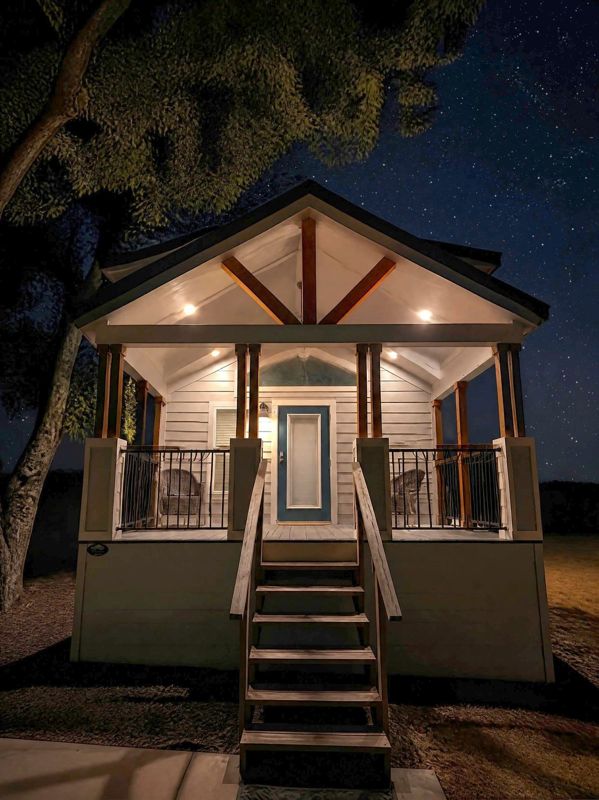
Our tiny home sits on farmland outside Waxahachie, about 25 minutes from the old campus and 8 minutes from the courthouse square. It sleeps up to 7, with a full kitchen and a porch for arguing about what the Super Collider might have found. Ask about booking direct, or check our dates on VRBO.
Sources and further reading
- Superconducting Super Collider, Wikipedia: specs, votes, costs, and what happened to the site.
- Ellis County genealogy archive: a Department of Energy fact sheet, a 1994 federal physics panel report, a 1992 critique, and a 1998 AP story on the land sale.
- Whatever Happened to the Superconducting Super Collider?, The New Republic, December 2011.
- Magnablend reopens former Super Collider facility, Business Facilities, August 2013.
How far is everything from the tiny home?
| From the tiny home to | Distance | Drive |
|---|---|---|
| Courthouse square and the Ellis County Museum | 3.7 mi | About 8 min |
| The former Super Collider campus (private, no visitors) | 10.5 mi | About 25 min |
| Downtown Dallas | 31 mi | About 35 min |
Estimated drive times from the tiny home without traffic, October 2026.
Questions we get
Where was the Superconducting Super Collider built?
In Ellis County, Texas, around Waxahachie. Its main campus was west of town, and its 54-mile ring was planned to circle the area underground.
What happened to the Superconducting Super Collider?
Congress canceled it in October 1993 after about $2 billion had been spent and about 14 miles of tunnel had been dug. The tunnels were flooded, Texas sold the land and buildings, and a chemical company, Magnablend, now uses the main campus.
Why was the Superconducting Super Collider canceled?
Mostly cost. Estimates climbed from $4.4 billion in 1987 to about $12 billion, the GAO found a $630 million construction overrun, and the House had already voted against it once in 1992.
How much money was spent on the Super Collider?
About $2 billion, including about $400 million from Texas and the rest from the Department of Energy.
How long is the Super Collider tunnel?
About 14 to 14.6 miles (22.5 to 23.5 km) was finished before the project was canceled, depending on the source. The full ring would have been 54.1 miles around.
Can you visit the Superconducting Super Collider in Waxahachie?
No. The main campus is an active chemical plant on private property and is closed to visitors.
Who owns the Super Collider site now?
Magnablend, a chemical company, bought the property in 2012 and reopened the buildings in 2013.
Would the Super Collider have found the Higgs boson?
It was designed for about three times the collision energy of CERN's Large Hadron Collider, which found the Higgs in 2012. The SSC's former director, Roy Schwitters, has said he thinks it would have found it about 10 years earlier.
About this guide
Written by the hosts of The Waxahachie Tiny Home, a family-run rental on farmland just outside Waxahachie. We checked the details on this page against official sources and update it as things change. Hours, prices, and dates move around, so confirm before you go.
Last updated October 17, 2026
Looking to be included in our guides?
Run a restaurant, shop, venue, or something fun nearby? Send us your details and why we should include you.